Sunday, 10 July 2011

Artisan Speciality Breads for Chorleywood

My first stall at the Chorleywood Village Fayre


Saturday was a HUGE day for me. After 10 months of studying bread making at The School of Artisan  http://www.schoolofartisanfood.org/ it was the chance for me to prove myself as a real artisan bread maker in my home village of Chorleywood. Ironically, the very place back in 1961 where the Industrial loaf was born.

So what to bake ? 

After a week of deliberation and several different production schedules (its like planning a military operation when you only have a tiny kitchen with one domestic oven and no mixer!) I decided that I would leave the standard white, wholemeal and malthouse to the other bakeries and go to town with sourdough, overnight fermentation, enrichment and natural additions of fruit, nuts, seeds, honey & beer.
I had to consider that each bake took 30 minutes, I could only fit 3 x 900g tins and 5 x 400g tins into the oven and I wanted to present my bread as fresh as possible. So I started baking at 4pm and finished my last loaf at 9.15am. I headed off to the fayre at 9.45am with a car smelling of wonderfulness. Here's what I baked...

Fruit bread (with raisins, fig & apricot)
Pain de Campagne
Focaccia (Rosemary & Rock Salt + Olives & Feta)
Cottage Loaves
Raisin, fig, walnut & cinnamon
Olive and feta bread wrapped in pine nuts & sesame seeds

Fruit Bread with raisins, figs & apricot
Fruit Bread
I managed to fit 5 x 400g tins into the oven and then trayed a couple freestyle.

830g Strong White Flour
200g Light Rye
650g Water
400g Rye Sourdough
20g Salt
20g Fresh Yeast
20g Honey
400g Raisins
200g Figs
100g Apricots

1) Mix by shearing the dough and working the gluten (leave fruit until the end)
2) Bulk ferment for 1 hour in a plastic tub
3) Scale out and round into balls. Rest for 20 minutes covered with plastic sheet on the side.
4) Mould and shape into tins or baton shape to bake on a tray
5) Prove for 2 hours - important that they double in size
6) Bake in pre-heated 250 oven turned down to 220 for 25-30 minutes. Keep your eye on them, sometimes good to turn down to 210 in the last 10 minutes of baking.

Pain de Campagne
Pain de campagne with cheeky photo;-)

I made 3 x 900g loaves and 1 x 500g that fit into one oven load. I wish I could have made more as they were so popular. So many people asked for bread without yeast. This 100% sourdough loaf with a mix of wheat & rye flour was perfect. 

Pain de Campagne
1000g Strong white flour
400g wholemeal
200g dark rye flour
600g white sourdough
1200g water
28g salt

1) Mix using shearing method and rest then return every 10 minutes or so (gives you time to get on with other things!)
2) Bulk ferment for 1 hour in a plastic tub
3) Scale out and round into balls. Rest for 20 minutes covered with plastic sheet on the side.
4) Mould and shape into tins or baton shape to bake on a tray
5) Prove for at least 4 hours - important that they double in size
6) Bake in pre-heated 250 oven turned down to 220 for 30-35 minutes. 

with olives & feta
with rosemary & rock salt
Focaccia (Rosemary & Rock Salt + Olives & Feta)

These went down brilliantly and easy for handmade production as I could use baking trays and get two trays into one oven load. I sold them sliced and whole and they looked amazing.

815g White Flour
700g water
1200g Biga (overnight dough)
32.5g Salt
15g Fresh Yeast


To make the Biga (I prepared at 1.30pm on Friday to bake at 1am on Saturday morning):
825g White Flour
463g Water
15g Fresh Yeast

1) Mix
2) Bulk Ferment in handful of olive oil for 1.5hrs (folding every 20 minutes)
3) Rest 30 minutes
4) Scale out or tray up
5) Bake at 230 with topping of your choice
6) Drizzle olive oil over when straight out of oven

Labels created by Abbie
My Royal Loaves
I have absolutely loved making cottage loaves throughout my course and they are special to me because they are beautiful British heritage loaves that you don't see so much anymore and we baked them for Prince Charles when he came to visit us at the school. 
This recipe made me 5 cottage loaves scaled out at 200g (bottom) and 100g (top). I also had a little left over so filled the old tiny Hovis tin I had.
Pre-ferment (stiff poolish overnight): 
840g Strong White Flour
504g Water
6g Fresh Yeast
Final (production) Dough:
1350g Pre-ferment (stiff poolish)
210g Strong White Flour
2g Fresh yeast
21g salt
31g butter
10g lard
90g beer (i used river cottage stinger ale - anything malty is good)
21g honey

1) Mix
2) Bulk ferment for 1 hour
3) Scale, mould and shape into balls (200g and 100g)
4) Rest 10 minutes
5) Mould into tighter balls and dock centre with thumb. Press thumb directly through the top to dock the smaller onto the top (the upper crust!)
6) Slash each loaf 8 times using a serrated knife (watch your fingers!)
7) Place on baking sheet and prove until double in size (about an hour)
8) Bake in pre-heated 250 and turn down to 220 for 30 minutes. Use steam by filling bottom tray with water.

Raisin, fig, walnut & cinnamon

Everyone loves a fig & walnut and these are great simply sliced with butter for tea or laden with a spread of blue Stilton. I made five loaves - some in tins and some baton shaped. Andrew Whitley's wife loved these so much she bought two:-)

1000g Strong White Flour
400g Wholemeal
32g Salt
200g Walnuts
300g Raisins
200g Figs
680g White Sourdough (nice & bubbly)
1000g Water

1) Mix
2) Bulk ferment for 1 hour
3) Scale in to balls and rest for 20 minutes covered on the side
4) Mould and shape into tins or baton shape
5) Prove for about 3 hours until double in size
6) Sift flour and slash with knife before baking
7) Bake in pre-heated 250 and turn down to 220 for 25-30 minutes. Use steam by filling bottom tray with water.


Olive and feta bread wrapped in pine nuts & sesame seeds
This speciality bread was introduced to me by British Baker Wayne Caddy. It was a real winner at the fayre. They look absolutely stunning. It was difficult for me to price them because they are oozing with mixed kalamata greek olives and feta cheese and wrapped in pine nuts (a pricey nut!) so they are certainly rich in ingredients (and time with an 18 hours pre-ferment)! I priced them at £3.50 and sold out within the hour. I think I could have pushed £4.50? I hate the fact all 'bread' is tagged as a low value item. Its CRAZY!
I made 6 x 300g loaves with some dough to spare

1250g Strong White Flour
500g Water
38g Salt
100g Olive Oil
7.5g Fresh Yeast
1500g Poolish (liquid poolish overnight)
To make the overnight liquid poolish:
750g White
750g Water
3g Fresh yeast

1) Mix until silky
2) Divide loosely into 600g and rest covered on the side for 30 minutes
3) Stretch into slipper shape. Rest for 10 minutes further.
4) Roll out with rolling pin to about 1 cm or so thick.
5) Add mixed olives and crumbled feta cheese and roll up.
6) Coat in toasted, crushed pine nuts, sesame seeds & semolina.
7) Cut through the middle with a sharp knife and turn upside so you see the olives on the top and place into a greased tin. Prove for 60 minutes.
8) Bake at 230 for 30 minutes with steam

I hope you enjoy these recipes and I will keep you posted as to what I will do next - bakery & bread school coming soon!


Retiring the Supermarket Loaf!
This year marks the 50th anniversary of the industrial loaf, made in large scale factories using a high speed mechanical process which relies on additives to ensure consistency and longlife (80% of UK bread is still made this way!) and so a massive PR opportunity for the Real Bread Campaign to educate people on the difference between real bread and the additive laced supermarket loaf http://www.bbc.co.uk/news/magazine-13670278. The Flour Milling Association that created the Industrial loaf is now a retirement home and so alongside Andrew Whitley and Chris Young we RETIRED the supermarket loaf!

Saturday, 2 July 2011

Buckwheat Blinis at Derby Summer Food & Craft Fair

Today we were at the Derby Summer Food & Craft Fair and what an amazing venue. The Roundhouse in Pride Park is a magnificent Grade II listed railway site where the locomotives and old carriages used to get repaired. It recently had a complete makeover as part of a £48 million pound regeneration programme.
At The School of Artisan Food stand, Joe and I prepared some tasty Buckwheat Blinis with creme fraiche strawberries & blueberries. 

The gluten free Buckwheat flour gives a distinct taste that reminds me a bit of sesame paste. It went really well with the sweetness of the blueberries, strawberries and the cool creamy finish.
Buckwheat Blinis with creme fraiche
strawberries & blueberries
So if you fancy making these at home here's the recipe:
Buckwheat Blinis
Ingredients:
70g Buckwheat Flour
70g Plain Flour
1/3tsp Baking Powder
1/3tsp Dried Yeast
175ml Warmed Milk
1 egg separated
125g butter
Toppings: Creme Fraiche, Strawberries & Blueberries


Method:
1) Prepare a pre-ferment by dissolving your dried yeast into warm milk.
2) Sift your Buckwheat, Plain Flour and Baking Powder together.
3) Add the yolk only to the milk/yeast mixture and 1tspn of melted butter.
4) Then whisk your milk/yeast/yolk mixture into the dry mixture to form a batter.
5) Next whisk your egg white until it forms stiff peaks. 
6) Then fold this into your batter mixture carefully to ensure you keep the aerated volume and whippy texture.
7) Clarify some butter by warming it up so that the white and yellow liquid separate. Keep the yellow liquid to use as a greasing agent before you drop a large teaspoon of batter into the hot pan to make your blinis.
Top with fresh fruit or a popular topping for these Russian pancakes is smoked salmon.


Friday, 24 June 2011

What is your favourite muffin?

This week we went in search of the perfect muffin. A crumbly crunchy top with a soft cakey centre that's not too moist and not too dry and not too sickly. We started with a basic muffin recipe (see below) and added lots of different ingredients to get the perfect flavour combinations.

We created classic combinations like Blueberry, Chocolate chip, Banana, Honey & Ginger, Apple & Sultana, Cherry & Almond, Lemon & Poppy Seed, Breakfast Bran and then thought of some wilder alternatives such as Strawberry, Balsamic & Black Pepper - i need to try this one!

Classic Blueberry
Chocolate chip
Breakfast Bran - delicious & nutritious
Right two: Cherry & Almond / Banana
The savoury options were a great success...

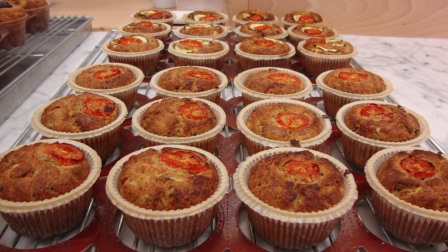
Cheese & Sunblushed Tomato
Black Olives, Pesto & Pine nuts
Courgette, pine nuts & sundried tomato with
goats cheese center 
Basic Muffin Recipe (make about 24)

Plain Flour  810g
Eggs 5
Dem Sugar 450g
Sunflower Oil 250g
Milk 450g
Baking Powder 20g
Salt 15g
Additional choice of fruit 400g

Method:

1) Sift flour, baking powder, spices (if using any) & set aside
2) Mix oil and milk together
3) In mixing bowl whip the eggs, salt and sugar until light and creamy. I used a hand whisk for around 8-10minutes
4)Then when egg mixture is light and creamy slowly pour in the milk and egg whilst continuing to whisk.
5) Then fold the flour into the egg mixture - don't over fold as okay to have lumpy bits in muffins
6) Finally fold in your chosen sweet or savoury flavour.
7) Fill your muffin cases a few mm from the top.
8) Bake at 180 for approx 25 minutes - some wetter fillings take a little longer so keep your eye on them and use a knife to check middle and it comes out clean.

Enjoy. I like ice cold milk with the sweet ones and a glass of prosecco with the savoury :-)

Tuesday, 24 May 2011

I can’t believe it’s Gluten-free!


There is a market out there for gluten-free products, but is it being served ? In my opinion, wheat intolerant or coeliac disease sufferers have every right to enjoy freshly baked breads, cakes and pastries.  According to Coeliac UK, 1 in 100 people suffer from the disease, which can cause great discomfort and quite a list of more serious symptoms. So why are freshly baked gluten free products so hard to find? I am not sure I know the answer to this, I could hazard a guess that gluten-free is seen as an area of baking that is too niche to cater for, expensive to produce due to the variety of alternative flours needed and perhaps there is not the inclination to create a variety of gluten free products because it is an unknown area.

Why should coeliac sufferers miss out on all the yummy goods most of us can access without any painful side effects? This week’s baking with Emmanuel Hadjiandreou (his book is out soon!) proved that we could offer some tasty gluten-free alternatives, and dare I say it, our chief tasters couldn’t even tell the difference!

Just to clarify, true gluten-free means NO wheat flour, NO rye flour and NO spelt flour. For the baked goods below we used; Plain gluten-free flour from Doves Farm, Buckwheat Flour, Potato flour, Maize flour, Rice flour and Chickpea flour (aka Gram flour). All these flours are related to wheat flour as sub-species in some form but they do not contain gluten (large protein molecules) that exist in wheat flour. Gluten provides the elasticity in the dough and supports the crumb structure so you get a chewy, aerated and well risen loaf.  In gluten-free bread this is substituted with other carbohydrates or starches that develop long chains to link the structure together eg. Xanthum gum, which is a type of starch produced by fermentation and improves the texture when combined with gluten-free flour. 
For info; Khoresan (aka Kamut) DOES contain gluten so not suitable for Coeliac sufferers.

When baking gluten free products, the important things to consider are:
1)      Ingredients (balancing the flavours of the gluten-free flours that you use)
2)      When mixing your dough for bread making, you are looking for a much wetter, almost batter like consistency.
3)      Be creative. Enrich your doughs to improve flavour with seeds, fruit and spices.
4)      Trial your gluten free products with coeliac sufferers. Ask them what they think and how you might improve them.
Fruit spiced, seeded & buckwheat
Mini tarts filled with real jams & mini bakewell tarts.

Seeded sourdough (overnight long fermentation)
Pear & ginger frangipane tart (with ground chestnut)
Chewy chocolate chip cookies 
Deluxe chocolate cookies with dark chocolate &coffee
topped with hazelnut, cherry & almonds
 (with thanks to Russell)


Sunday, 22 May 2011

Derbyshire Food & Drink Festival

Thank you to all the visitors that stopped to chat and enjoy the tasters we were making. Several folk asked for the recipe for the Roomali Indian flat bread with cool corriander filling. So here it is...enjoy!
Roomali Flat Bread 
Translated Roomali means "handkerchief". We were introduced to this recipe during last week's baking class with British baker Wayne Caddy from Essential Baker http://www.bakeryconsultants.com/ who enjoyed this food so much during his travels to India. He showed us a variety of tweaks to the traditional flat bread recipe that could be found wrapping a variety of hot and cold fillings on the streets of Mumbai. Below is the recipe we prepared at the show. It was a big hit with visitors as they jostled four deep to grab a mini wrap of warm Indian yumminess with cool fragrant filling.

Plain Roomlai flat bread
Plain flour 500g
Atta Flour 500g
Salt 20g
Water 550g (+/-)
Ground Black Pepper 1g
Ghee 20g
1 egg
Method
1) Place all the ingredients in a bowl and mix using a Kitchen Aid for 8-10 mins. You can also mix by hand but ensure that the dough has completely come together. If you are getting tired, you can always leave covered in the bowl, let it rest and come back to it in ten minutes or so for another knead.
2) Once fully mixed, leave the dough to rest for 2 hrs in a covered bowl. 
3) Then scale the dough into 80g portions by rolling into round balls and placing on tray lined with baking paper.
4) Cover the tray with cling film (lightly dust the balls with flour do they don't stick).
5) Rest for 2 hrs (important so that the dough relaxes and doesn't shrink back on you when you are rolling out)
6) At this stage you can store them in the fridge for up to 48 hrs or you can bake off.

7) Roll out very thin 12inch rounds, dusting with flour as you go.
8) The pan needs to be really hot for a rapid bake (just a touch of oil needed for the first one) and you will see bubbles appear as it cooks on each side. You can either use a pan OR you can use an upturned wok if you have gas. This was really effective.
9) Fold over the sides so you form little Roomali pouches. Fill and serve warm.


For a cool, fragrant filling we mixed together cottage cheese, spring onion, lemon juice, paprika, corriander, cumin, black pepper and salt to taste. Added chilli for hot&spicy. When we ran out of cottage cheese we used creme fraiche. Both went down a treat.


Friday, 20 May 2011

Dottie about Stottie cake

Celebrating a regional favourite from the North East of England, the stottie cake (more of a bread really), is the perfect canvas for sandwich fillers (hot or cold) or mopping up a hearty stew. This stottie was a first for me and definitely one to write home about - way aye man! Thanks to our great British baker, Wayne Caddy for sharing this with us.
Stottie recipe:
Strong white flour 1000g
Fresh yeast 30g
Salt 20g
Lard 40g
Water 550g (+/-)
Milk Powder (or replace the water with milk) 20g
Sponge 380g
Sponge recipe (make overnight):
Strong white flour 1000g
Fresh yeast 3g
Water 550g


Method:
1) Mix the sponge the day before and ferment for 18-24 hrs at ambient temperature.
2) Mix the stottie dough by hand until well developed, soft and silky (like a babies bottom:) or you can use a mixer for 6-8 mins
3) Keep covered and ferment for 1hr
4) Scale dough pieces at 400g and round. Then cover and rest for at least 15mins.
5) Roll out the dough to form a round disc of around 20cm in diameter and approx 1/2cm thick. Place on a baking tray and prove for 40-60 mins.
6) Just before baking stick your thumb in the centre of the disc to dock and stop movement/rise whilst baking.
7) Bake for 10 mins if on a tray at 230 degrees or 8 mins if direct on the stone. Turn the stottis over about 2/3rds of the way through baking.
Serve as sliced wedges


Wednesday, 18 May 2011

Strawberry Tarts Forever


The French need no introduction in this department. In my opinion, they have it oh so right in every way. What can be better than picking up a little something sweet to lift you out of the daily grind. Something that tastes amazing and is not extortionately priced because it IS amazing and leaves you feeling a little naughty but not sickly, because if persuaded you could probably have another. 

Why can we not readily pick this up from a Boulangerie/Patisserie on every high street? (Mary Portas take note). After all it was just a biscuity base of short crust pastry, some cool strawberry chantilly cream, topped with sweet fresh strawberries neatly boxed and politely delivered with a 'Merci' from the smartly dressed lady serving. Altogether a heavenly combination of perfectness that made me very happy as I skipped out the door and indulged without a calorific care in the world.
Back home now! It saddens me that there are 1500 Greggs outlets in the UK (I can't believe I am mentioning this name on the same page as a French patisserie!) and a further 80 store openings due this year. Wouldn't our high streets look a lot prettier with some independent bakeries? Surely the beautiful handmade pastries and breads on offer beat a greasy sausage roll meal deal served by a spotty teenage kid! Non?